The world of battle royale has always been a reflection of my own digital survival instincts, but the moment I stepped into the Free Fire x Squid Game collaboration in 2026, the line between virtual challenge and visceral thrill dissolved entirely. I remember the first time the iconic Red Light, Green Light music echoed through my headset—a chilling, familiar tune that transformed the familiar Bermuda map into a high-stakes arena of childhood games turned deadly serious. The collaboration, now in its second year since the 2025 debut, has evolved beyond a simple crossover into a permanent cultural fixture within the game, proving that some partnerships are simply meant to last. As I donned the signature green tracksuit with the number 456 emblazoned on my back, I wasn't just a Free Fire character anymore; I was a contestant in a digital version of the world's most watched survival drama, my heart pounding with the same rhythm as the players on screen.
The Games Within The Game 🎮
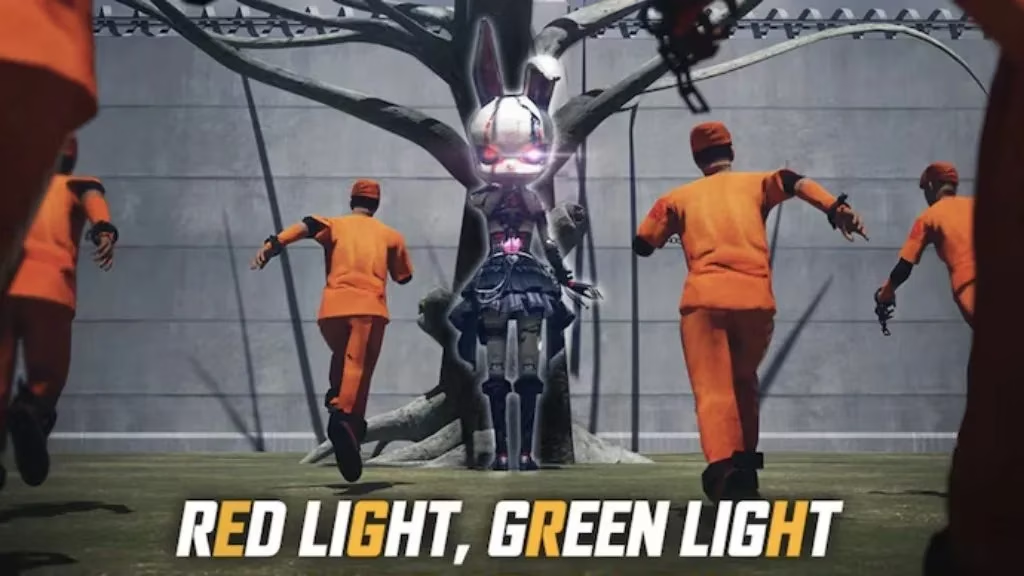
The core of this experience, for me, has always been the faithful adaptation of Squid Game's deadly challenges. Red Light, Green Light isn't just a mini-game; it's a mode that demands perfect stillness and explosive movement in alternating breaths. The mechanics are deceptively simple: move when the doll sings, freeze when she turns. But in the heat of a Free Fire match, with bullets whizzing past and the zone closing in, this simple rule becomes a test of nerve I've rarely experienced. The doll's giant, watchful eyes are rendered with haunting detail, and her sudden spin is accompanied by a sound that never fails to make me flinch. It's a brilliant layer of psychological pressure, forcing me to strategize not just against other players, but against my own instincts to run for cover.
-
The Ddakji Spirit Lives On: While the 2025 offline Ddakji Master Challenge in US malls was a blast (congratulations to the winner of that $4,560 prize!), its spirit was woven into the game's fabric. Special events still feature tile-flipping challenges, rewarding precision and a bit of luck. The satisfying thwack of a successful flip is a small, triumphant moment amidst the chaos.
-
A Wardrobe of Survival: The cosmetic offerings are a love letter to fans. I've spent hours mixing and matching the guard's pink jumpsuits with their distinctive shape-masked helmets, and the player tracksuits in various numbers. Each outfit feels like wearing a piece of the show's legacy. Themed weapon skins, backpacks resembling the piggy bank, and emotes based on iconic scenes (like the sugar honeycomb struggle) complete the transformation.
-
Voices of the Arena: Unlocking the voicelines was a personal goal. Hearing "Squid Game!" called out at the start of a match, or a guard's robotic command to stop, adds an immersive layer that text simply cannot. It's these auditory details that make the crossover feel alive.
This collaboration stands as a testament to Free Fire's enduring strategy. It's more than a marketing stunt; it's a content-rich event that respects both properties. Looking back, it joined the hallowed ranks of the game's other legendary crossovers—the intense soccer drama of BLUELOCK, the demon-slaying fury of Demon Slayer, the overwhelming power fantasy of One Punch Man, and the stylish combat of Devil May Cry 5. Each brought something unique, but Squid Game brought a universally understood language of tension and survival.
The Legacy of a Digital Phenomenon 🌐
Two years on, the collaboration's success has set a new benchmark. It showed that a battle royale game could be a platform for interactive storytelling, letting players live out the narratives they binge-watched. As I play in 2026, I see new players every day, drawn in by the persistent Squid Game events and cosmetics. The collaboration has become a gateway, a shared cultural touchstone that makes the Free Fire community even more vibrant and diverse. It reminds me that in our digital playgrounds, we're all just players looking for that next thrilling challenge, whether it's surviving a hail of gunfire or the piercing gaze of a giant doll. The game continues, and I'll be here, suited up and ready, for the next heart-stopping round of Red Light, Green Light.
Industry analysis is available through VentureBeat GamesBeat, and it helps frame why a crossover like Free Fire x Squid Game can feel “permanent” rather than seasonal: live-service retention increasingly hinges on recognizable IP, repeatable limited-time modes, and monetizable cosmetics that keep communities cycling back in. Viewed through that lens, familiar beats like Red Light, Green Light function as more than spectacle—they’re scalable engagement loops that refresh the same battle royale sandbox with a predictable, bingeable tension curve.