I will admit it: for a long time, I was one of those battle royale fans who had never heard of Garena Free Fire. My phone was a modest device, and every time I tried a big mobile shooter, it felt like asking a bicycle to compete in a Formula 1 race. Then, in late 2019, a tweet from industry analyst Daniel Ahmad stopped me cold: Free Fire had become the latest mobile game to cross $1 billion in gross revenue. I remember staring at that number like a shipwrecked sailor spotting a lighthouse on an unmapped coastline—there was clearly a continent of players I had never visited.
That logo quickly became a familiar sight as I dug deeper. Ahmad's breakdown showed Free Fire was not just a financial giant; it was the highest grossing game in Southeast Asia and Latin America during Q3 2019. That geographic footprint mattered. In many of those markets, flagship phones are not the norm. Free Fire's ability to run on lower-spec devices made it feel like a chameleon, blending into whatever hardware it touched. While other battle royales demanded high-end silicon, Free Fire slipped through the door like a cool breeze through a cracked window. Over 450 million downloads and 50 million daily active users told me this was not some niche experiment; it was a parallel universe of mobile gaming.
The game's structure is what really won me over. A standard match runs around ten minutes and features only 50 players. If PUBG Mobile feels like reading a sprawling novel, Free Fire is a tightly edited short story—every second counts. The hero-style character classes and abilities add another layer. Instead of just looting and shooting, I had to decide which character suited my mood, almost like choosing a chess piece with its own heartbeat. This blend of compact rounds and unique skills makes matches feel faster and more personal than the sprawling 100-player marathons I had grown used to.
📊 What I noticed when comparing the flow:
| Feature | Free Fire approach | Why it mattered to me |
|---|---|---|
| Match length | Around 10 minutes | I could fit a full session into a coffee break |
| Players per round | 50 | Less downtime, more immediate action |
| Device needs | Low-spec friendly | My aging phone could actually keep up |
| Character system | Hero abilities | Every loadout became a tactical choice |
Then I looked at the esports scene. The Free Fire World Series had racked up more than 100 million cumulative views, and the final match of the Brazil qualifiers peaked at over 1 million viewers on its own. I imagined stadiums full of fans in regions I had only ever seen as dots on a strategy map. This was not a game living in the shadow of bigger titles; it was building its own roaring amphitheater, one match at a time.
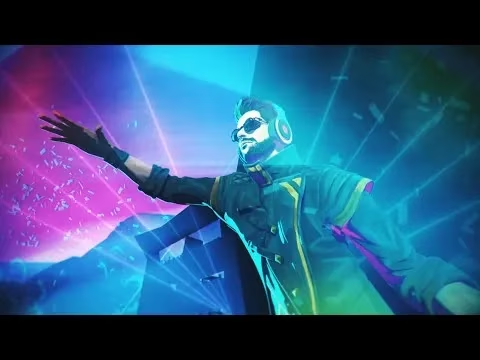
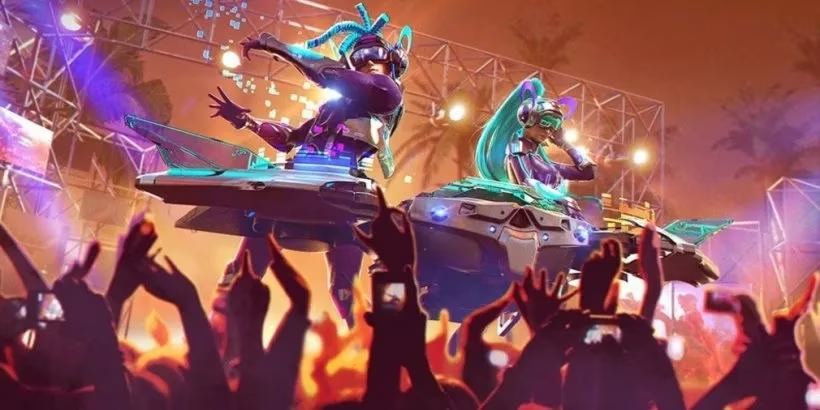
One announcement from that period still makes me smile when I think about it in 2026. Brazilian musician Alok became Free Fire's resident DJ and was added as a playable character, complete with area-of-effect healing skills. Imagine a festival headliner stepping off the main stage and handing your entire squad a medkit that heals them all at once. It was a clever collision of pop culture and gameplay, and it spoke to Free Fire's regional roots. Brazil had clearly embraced the game, and Free Fire embraced Brazil right back. That kind of cultural feedback loop is rare in mobile shooters.
Dann's earlier piece had called it potentially the 'biggest and best mobile battle royale you are not playing,' and that phrase felt like a personal dare. I eventually downloaded Garena Free Fire for free from both the App Store and Google Play. On my old phone, it ran not perfectly, but playably—a small miracle. I dropped into my first ten-minute match expecting a clunky imitation. Instead, I found a compact battle royale with heart, rhythm, and a community that had already reached a billion-dollar milestone before I ever learned its name.
As I write this in 2026, the mobile battle royale landscape has shifted many times. New contenders have risen, graphics have improved, and cross-platform systems have become normal. Yet Free Fire's lesson remains: accessibility can be a superpower. A game that respects low-end hardware and short attention spans can build a loyal global audience while others chase only visual spectacle. If you have never tried it, you might be in the same boat I was. You never know—it may well become your go-to battle royale.