The mobile battle royale landscape was forever changed when Garena Free Fire announced its grand collaboration with the legendary anime One-Punch Man. The event, titled 'The Hero Trial,' began on January 10th, 2026, plunging millions of players into a world where martial arts, monster hunting, and superhero antics collided. From the very first log-in, it was clear this was no ordinary crossover; it was a full-scale invasion of iconic characters, exclusive cosmetics, and web-based treasure hunts that demanded both firepower and dedication.
The initial response from the community was electric. Players who had been following the teaser trailers for weeks finally saw the game transform before their eyes. The main lobby screen adopted the striking minimalist aesthetic of the Hero Association headquarters, with Saitama’s impassive face looming in the background. The centerpiece of the entire event was the Hero Trial interface, unlocked on January 15th, which served as a gateway to a series of special training missions. To embark on these missions, one first had to collect One-Punch Man Tickets from random in-game drops—a mechanic that turned every normal match into a frantic scavenger hunt. These tickets were the keys to facing off against waves of digital monsters, each defeat yielding loot boxes of varying rarity.
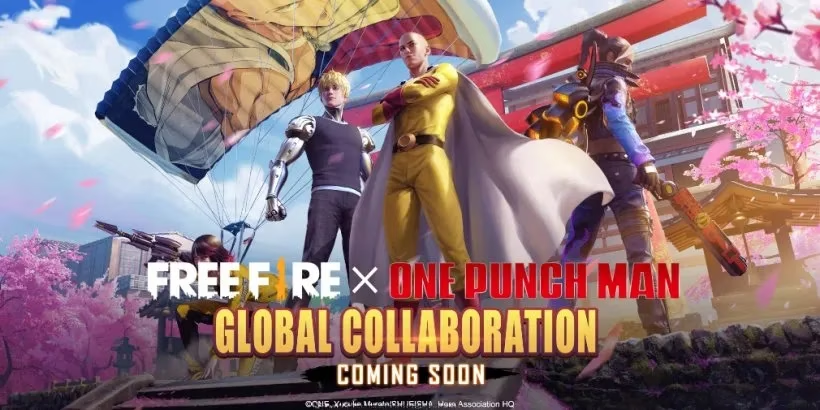
For the fashion-forward survivors, the collaboration delivered an unexpected dose of humor and style. One of the most talked-about items was the Saitama Pajamas costume—an exact replica of the hero’s lazy-day attire, complete with a cap and slippers. Equipping it gave players a strange sense of invincibility, even if it provided no actual stat boosts. Equally popular was the villain-inspired backpack, which was designed to look like a menacing, pulsating lump of cellular mass from the series' monstrous rogue gallery. The backpack bounced grotesquely as players sprinted across the map, drawing both laughter and gasps. And then there was the ""I'm Saitama"" emote, a perfect circle of bald-headed nonchalance that quickly became the universal signal for ""this fight is beneath me."" Activating it after scoring an elimination was considered the ultimate flex.
Weapon enthusiasts were not left empty-handed. Two devastating skins became available: the Megapunch M1887 and the Megapunch M4A1. Both featured a vibrant red-and-yellow glove motif that seemed to scream ""ONE PUUUUNCH!"" with every shot. The M1887 skin, in particular, turned the already lethal shotgun into a close-quarters nightmare, with a firing animation that included a miniature shockwave effect. Players who logged in before January 23rd were also gifted a free Saitama Surfboard skin. This sleek, bright-white board was adorned with the hero’s signature face, and dropping onto the battlefield from the plane now felt like surfing into a brawl. Friends would often synchronize their landings, creating a bizarre parade of bald heroes skipping across the water.
The most intricate part of the collaboration, however, was the web-based event titled The Path to Hero, which went live from January 16th to January 26th. This was a standalone narrative maze that could be accessed via a smartphone browser or tablet. The premise was simple yet addictive: players guided their avatars through a series of dark, treacherous corridors filled with monsters. Each encounter was a quick-time battle; winning granted treasure boxes containing exclusive tokens. These tokens were the real currency, exchangeable for a wide array of rewards in the event’s redemption store—from permanent character skins to rare gun camos. The twist was that movement through the maze required exploration tokens, which could only be earned by completing daily missions inside the main Free Fire app. This created a perfect loop that kept the community engaged throughout the entire winter month.
The gaming forums buzzed with strategy guides and token optimization charts. Alliances were forged purely for the purpose of sharing daily mission completions more efficiently. Some players logged in during their lunch breaks at work, not to play a full match, but just to secure those precious exploration tokens before the day’s reset. The event turned casual players into dedicated planners, and it reinforced the idea that Free Fire was no longer just a game; it was a living, breathing social platform.
As the final days of January approached, the sense of urgency peaked. The loot box drop rates became a hot topic, with streamers filling their channels with opening sprees that lasted for hours. The rarest items—including a Genos-themed motorcycle skin—became status symbols, signifying not just luck but sheer hours of grinding. On the last day of The Hero Trial, the skies above Bermuda were filled with surfboards and the sound of the Megapunch M1887, a fitting farewell to a collaboration that had seamlessly blended two wildly different worlds. By the time the event servers shut down, it was already being whispered that this would return someday, for every survivor knew: the hero never truly retires; he just finds a new grocery sale to hurry toward.